



Donald Trump runs the loudest distraction operation in modern American history. While he shouts about Iran or gilded visas or whichever living monument to an assassinated president that he has renamed after himself this week, the enablers, his family members, junior cronies – the Princelings – are helping themselves to your wallet. That division of labor is the whole point. The boss makes the noise. The Princelings come after you. Long-time readers will recognize every move in the playbook by now, and this week delivered something close to a master class.
Péter Magyar shellacked Viktor Orbán two weeks ago because Magyar recognized this, and weaponized anti-corruption to disassemble Orbán’s patronage network hammer and tong. He didn’t debate policy priorities or virtue signal. He refused to argue about climate policy or EU subsidies or whatever. Instead, he drove into towns and counties, naming local enablers and explaining how those enablers’ specific schemes were stealing from the very people he was addressing. He identified the neighbors growing rich off others’ paychecks. Transparency was his secret, unifying weapon.
That playbook belongs in every Democratic field office from Tyler to Williston. Trump’s enablers are stealing from Americans all over the country. They think that is their right. Well, it’s the pro-democracy coalition’s right to explain to MAGA’s marks who is doing it and how. Name names and don’t rely on the media to deliver your message. The algorithm will block it. Plus, the transparency campaigns need to be highly localized. These marks aren’t dumb or evil. They’re just uniformed. Inform them, and explain how the person they support is stealing from them. Don’t talk about Trump. Instead, get specific about the schemes stealing from them.
That’s the lesson from Hungary, and it is literally this organization’s mission to drive that point home. Anti-corruption is MAGA kryprotite. Think of this newsletter as identifying kryptonite deposits.
The son on Fox Business bragging about the contract
On Thursday morning, Eric Trump appeared on Maria Bartiromo’s Fox Business program next to Sankaet Pathak, the chief executive of a humanoid robotics startup called Foundation, to celebrate a twenty-four million dollar Pentagon contract the company had just won to build combat robots. Eric Trump is Foundation’s chief strategic adviser and a major financier. Senator Elizabeth Warren called it corruption in plain sight. It is that, but it’s also putting soldiers’ lives at risk to line tech bros’ pockets.
The identity of Foundation’s chief executive ought to have ended this deal at the security-clearance stage. Pathak previously ran Synapse, a “banking-as-a-service” fintech that filed for Chapter 11 in April 2024 and took roughly 100 fintechs and 10 million end customers down with it. The court-appointed trustee, former FDIC Chair Jelena McWilliams, reported a shortfall of $65 to $96 million between Synapse’s records and those of its partner banks. Fortune, in a lengthy postmortem, compared the wreckage to FTX and noted that Pathak’s own board had discussed removing him as chief executive a year before the collapse. Now, he runs a robotics company. Eric Trump has invested in it, and, entirely coincidentally, Trump’s Defense Department just gave him $24 million in taxpayer money to build war robots.
Just before that, the Pentagon unveiled Trump’s FY27 budget request of almost $2 trillion, which includes $75 billion earmarked for drones and counter-drones, including $54 billion for a new Defense Autonomous Working Group, up from $226 million this year. Ukraine’s entire 2026 defense budget is roughly $66 billion, and, in a historic first, Ukrainian forces just took a frontline position from Russia using nothing but robots. Trump is showering drone contracts on Princelings worth more than Ukraine will spend to hold its entire front line. Good news for Trump tech bros like Péter Thiel and his companies, like Anduril. Very bad news for American soldiers who will have to take the murderous frontline punishment, which Ukraine’s robots have already proven able to survive.
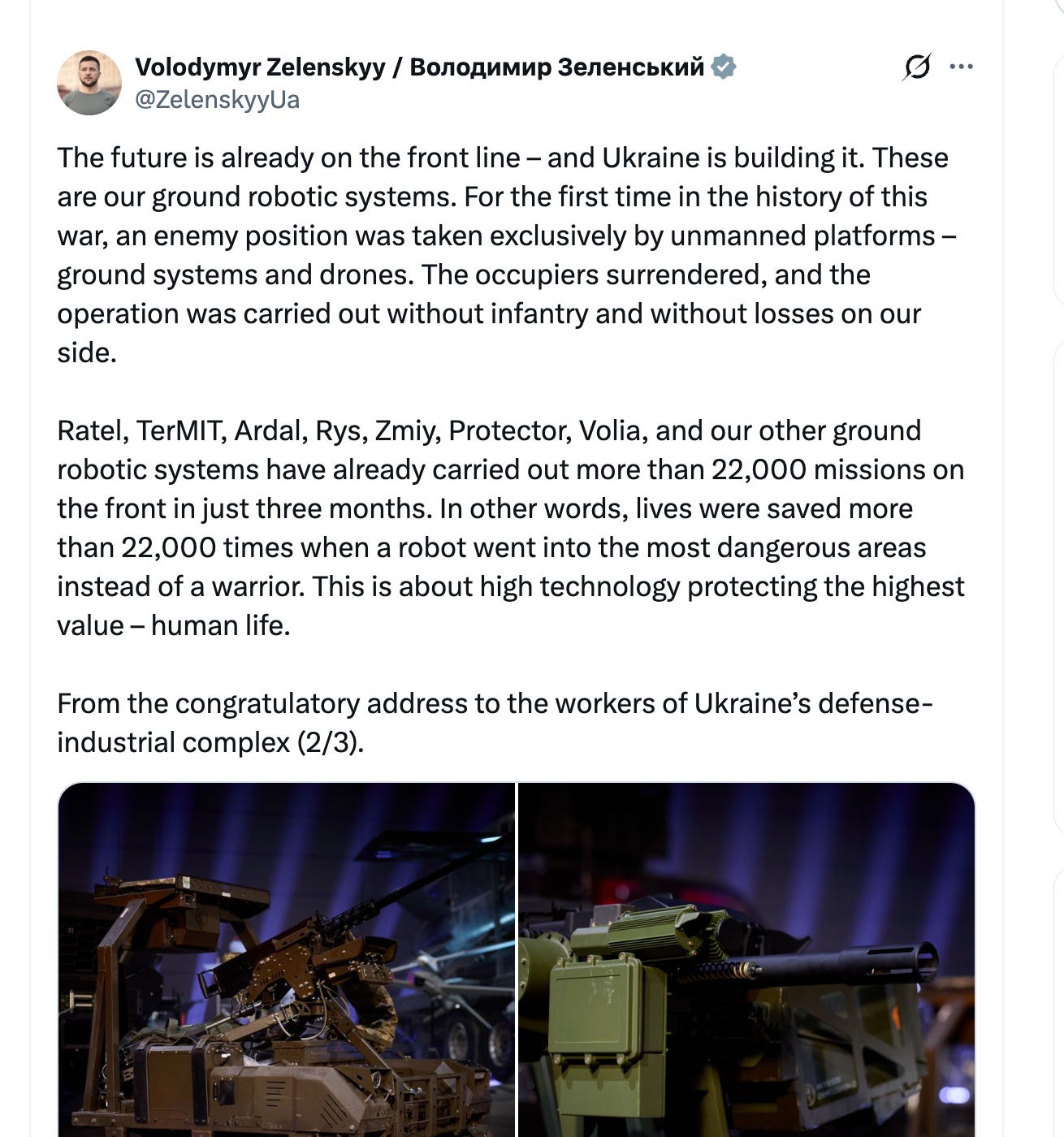
Eat your heart out, Eric Trump
On April 13, Volodymyr Zelensky announced Russian soldiers had surrendered to Ukrainian robots. On Thursday, the White House (which 100% saw Zelensky’s announcement) decided to risk the lives of your children in the military so that it could give Eric Trump and a disgraced fintech CEO billions of your tax dollars.
This isn’t a one-off. In February, a fiber-optic attack drone built by Ukrainian firm SkyFall won the Pentagon’s Drone Dominance Gauntlet I at Fort Benning, Georgia, more than ten points ahead of the second-place American finisher from California. SkyFall’s P1-SUN Shahed-hunter goes for $1,000 each. Ukraine has more than 150 manufacturers and produced 2 million drones last year. They are in the air tonight, saving lives — beating the best that Russia, China and Iran can throw at them and are the best in the world by a very wide margin.
Compare that to Trump’s “investment” priorities: Peter Thiel’s Founders Fund is the lead backer of Anduril Industries, which was valued at $66 billion in March. The Army just handed it a $20 billion counter-drone contract on March 14. It spent $250 million to buy 500 drones. For reference, Ukraine uses a drone every 15 seconds. In a modern warfare situation, the US military would run out of its drones after 2.08 hours. American soldiers will suffer a grueling 364.9 days. But Peter Thiel will have a nicer house.
The roughneck in Cameron Parish who loses his LNG terminal shift because Gentry Beach opened an Alaska back door for Novatek is the same taxpayer whose child will someday be told to dig a trench against Chinese autonomous systems and whose unit will run out of Thiel’s $500,000 untested drones. Thiel’s investors will get the margin, but the ground war gets the kid.
The billionaire who wrote the checks and now wants out
Tron founder Justin Sun spent two years buying himself a seat at the Trump family crypto table. He put $45 million into World Liberty Financial in 2024, built a token position reported at roughly $75, moderated a Dubai conference panel with Eric Trump and Zach Witkoff, and let himself be photographed with every Trump son who would stand next to him. It paid off. In March, Trump’s SEC “settled” a civil complaint against him for wash trading. On Tuesday, he filed suit in California federal court, alleging that World Liberty had illegally frozen his tokens and secretly changed the contractual rules governing who could transfer them. They allegedly threatened to burn his holdings unless he poured hundreds of millions more into minting World Liberty’s USD1 stablecoin. The complaint describes WLF operators Chase Herro and company as “running a golden opportunity to leverage the Trump brand to profit through fraud” and calls the company insolvent.
The person who wrote the biggest early check, flew the biggest flag, and sat on the biggest panels is now telling a federal judge under oath that the whole operation is a fraud. Congressional Democrats who were on the fence about the GENIUS Act and the WLF banking charter application should re-read the complaint and count the signatures. And those who saw clearly how shady this industry is should fan out and explain to voters how it will cost them money.
The Balkans pipeline and the circle we keep drawing
The Guardian put the Southern Interconnection story on its front page yesterday, reporting that the European Commission has been quietly pressing Sarajevo to delay the award of the one and a half billion dollar Bosnia gas pipeline contract to AAFS Infrastructure and Energy, a Wyoming shell company fronted by Trump’s personal election lawyer Jesse Binnall and by Michael Flynn’s brother Joseph (we have no idea who owns it). Most countries have folded before this administration over trade, Ukraine, and NATO spending. This is the first time a major country has moved to block a commercial venture run by a Princeling. Finally, we caught a glimpse of some vertebrae, and it came, from all places, from Brussels.
Relatedly, Trump Jr’s close friend, the Texas financier Gentry Beach, signed a separate deal with Russia’s second-largest gas producer, Novatek, to build floating LNG capacity in Alaska. Together, the Alaska opening and the Bosnia pipeline would help Russia claw back European gas market share that three years of sanctions have dismantled. Wood Mackenzie estimates that the return of Russian gas to Europe idles roughly 25 million tonnes a year of US LNG capacity. That is many Permian, Haynesville, or Marcellus wells capped early, countless welders sent home, and roustabouts told to find something else. Those are Trump counties, and they need to be informed how Trump Jr’s college roommate and Trump’s January 6th lawyer have cut deals with Putin that will cost these Trump voters their jobs. We cannot stress enough: informed, not lectured. People in an information bubble do not know this. Think of the algorithm as a modern Iron Curtain. The US once had huge, focused efforts to inform people behind the Iron Curtain. The pro-democracy coalition needs to relearn that skill and inform these people that Gentry Beach's new beach home came with a price of shuffling East Texas oil workers to the unemployment line.
The Kennedy Center whistleblower who would not sign the NDA
Former visual arts curator Josef Palermo published a long account in The Atlantic this week describing ten months inside Ric Grenell’s Kennedy Center, then sat for interviews with MS NOW, PBS NewsHour, and The Bulwark. The highlights form their own indictment. $2 million box seats with the president for a Les Misérables preview. A fundraising pitch delivered at an October 7 memorial while Grenell wagged a finger at guests about which room they needed to underwrite personally. An order to auction off the permanent collection so the reopening could feature different art. A request to display the work of an artist Grenell personally collects, which would have lifted the secondary-market price of Grenell’s personal holdings. Ten months, never a single all-staff meeting, some requests ignored because Grenell was posting from Croatia.
Palermo refused to sign a separation agreement with confidentiality and nondisparagement clauses in exchange for one more month of severance and health coverage. Senator Sheldon Whitehouse has had an investigation open since November. He now has a named whistleblower with documents. The Kennedy Center begins a two-year closure on July 4, which the administration calls a renovation and Palermo calls bankruptcy dressed up. Every senator on the Judiciary Committee should be asking for Palermo’s full documentary record by this time next week.
The gold card that nobody wants
Commerce Secretary Howard Lutnick testified to the House Appropriations Committee on Thursday that the Trump gold card visa, which he had publicly assured voters had sold $1.3 billion worth in a matter of days after its December launch, has, in fact, been approved for exactly one applicant. Lutnick did not address that. He assured the committee that the vetting process is the most serious in the history of government, a claim that would have landed better if the pending applicant were not reportedly Jeffrey Chao of TP-Link, a Chinese-linked company that Lutnick’s own department is simultaneously investigating for ties to the Chinese government. This story belongs here because these “golden visa” schemes have been tried worldwide and are always terrible for the issuing country. They do little more than import corruption and some of the wealthiest money launderers on earth. But Jared Kushner and Trump’s real estate company need clients, we suppose. A prime example of how bad these programs are is none other than Trump’s Canadian business partner, the aforementioned Justin Sun. He bought Grenadian citizenship and now shares it with a suspiciously high share number of Russian, Chinese and Chechen mobsters.
The Commerce Secretary, the stablecoin, and the Texas primary
On April 15, Bloomberg reported that Cantor Fitzgerald, the firm Lutnick’s sons run, has donated $10 million to Fellowship PAC, a crypto super PAC chaired by Tether’s head of government affairs Jesse Spiro. On April 21, Fellowship disclosed to the FEC that it was spending $1.75 million to support Ken Paxton in the Texas Senate runoff. Within forty-eight hours, senior Republican officials called Lutnick directly to stop it. Totally normal.
A firm owned by the Commerce Secretary’s children, whose largest client custodies roughly $80 billion through that same firm, gave $10 million to a PAC chaired by its own client’s chief lobbyist, which then tried to install the breathtakingly corrupt sitting Texas attorney general in the United States Senate. When Republican leadership panicked, the sitting Commerce Secretary received the complaint. Ethics counsel Kathleen Clark warned in March that Lutnick’s divestment of Cantor to his sons had created a new conflict rather than solving one. This week, Lutnick proved her right.
The special envoy and the special fund
Representative Jamie Raskin sent a letter on April 16 to Jared Kushner at Affinity Partners, pointing out the obvious. Kushner is now the Special Envoy for Peace, negotiating with Gulf monarchies on behalf of the United States government while simultaneously soliciting at least $5 billion in fresh capital from those same monarchies for his private fund. Affinity’s assets jumped to $6.2 billion at the end of 2025. This doesn’t even address the fact that Kushner was also negotiating with Trump’s largest business partner in the room about whether to put American soldiers at risk, for the benefit of Israel and the Trump clan investors.
Stealing from grandma
Joshua Nass, the lobbyist whose firm Merkava Strategies was paid roughly nine hundred sixty thousand dollars to secure nursing home fraudster Joseph Schwartz a Trump pardon, is now in plea talks with federal prosecutors in Brooklyn over an extortion indictment alleging he hired someone to intimidate a former client for five $500,000. The Schwartz pardon erased roughly $5 million in restitution committed against people’s grandparents in New Jersey, Arkansas, Pennsylvania, South Dakota, Nebraska, Massachusetts, Illinois and Florida. Every voter in those states should know Joshua Nass’s name. Go. Now.
Beating the dead horse
Péter Magyar beat Orbán for one reason. He taught local workers how local Trump enablers were stealing from them. He said the names out loud. To the people getting robbed. Over and over. A Democratic candidate in Texas this year should stand outside a Cameron Parish LNG terminal and read these names aloud. Gentry Beach. Joseph Flynn. Jesse Binnall. Novatek. A candidate in Pennsylvania can walk a Marcellus rig yard and explain what idled US capacity looks like on a paycheck. Addressing veterans, a candidate anywhere can point at a $24 million check cut to Eric Trump’s bankruptcy-recovery business partner. Magyar did not travel only to winnable districts. He traveled everywhere. That is the point. Attack the network, don’t just campaign for seats. When the network is busy defending itself, it has less capacity to feed off voters. The pro-democracy coalition is running to obliterate a system, not count seats.
This week alone, we handed the pro-democracy coalition seven fresh sets of talking points — one per day. Read the names aloud in the places where they matter.
If this newsletter is useful, please become a paid Substack subscriber. Or support the mission of the 501(c)(4), Dekleptocracy, that publishes it. We are funded entirely by small-dollar gifts.
The breadth and depth of the trumpian matrix corruption is daunting, BUT your work helps expose it.
You malcontents keep shouting into the abyss, a thousand words that no one pays any attention to. Surprised you don’t get it, nobody cares about your Anti American drooling. But keep it up you are just filling blank space on the internet with blank thinking…,