


CRYPTO CORRUPTION IN FOCUS
A federal appeals court told Sam Bankman-Fried no this week, and now the only person who can set him free is Donald Trump.
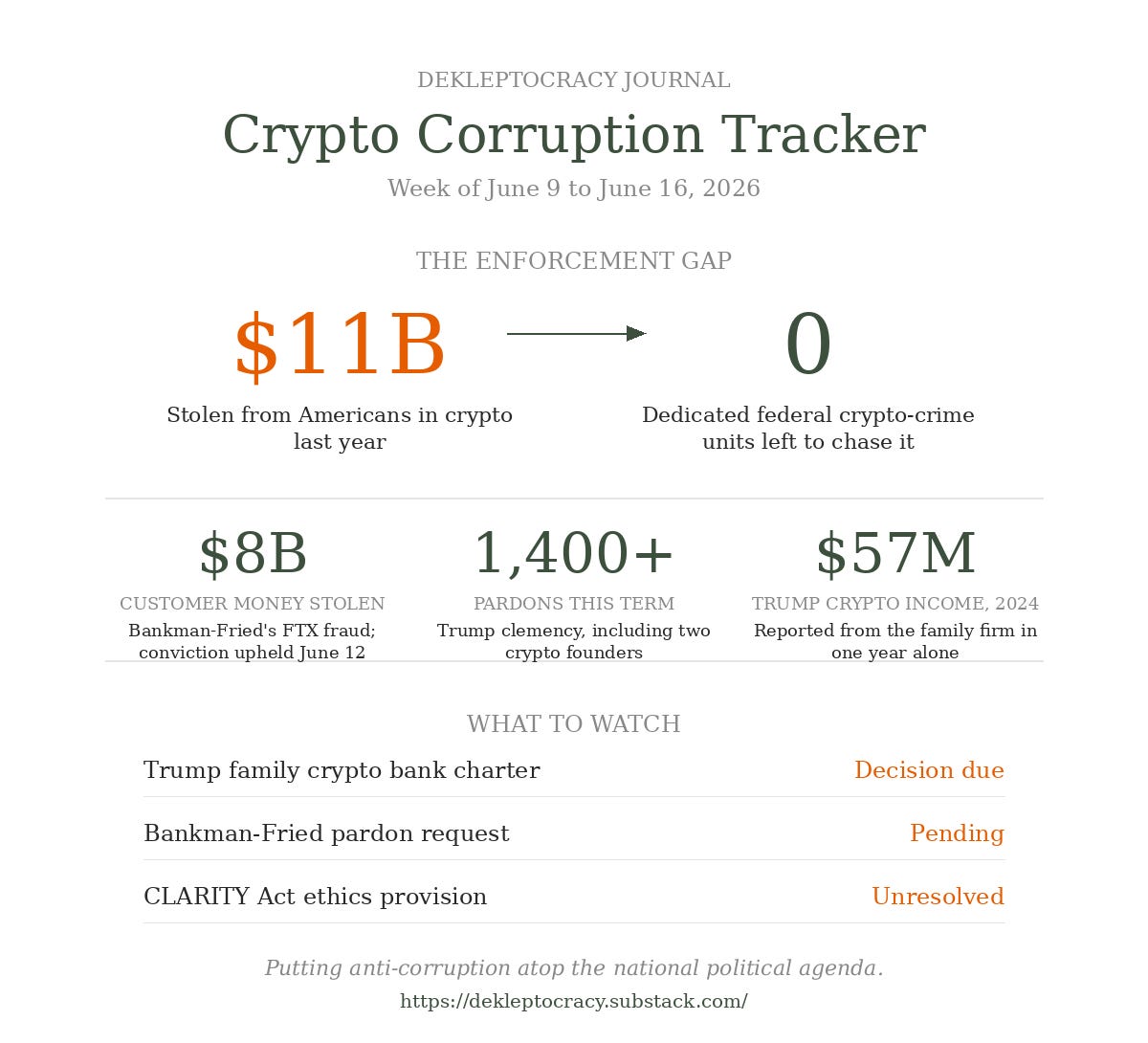
On June 12, the Second Circuit Court of Appeals in Manhattan upheld the fraud conviction and 25-year sentence of Bankman-Fried, the founder of the collapsed crypto exchange FTX. He stole roughly 8 billion dollars from customers who believed their money was safe. The three judges, two appointed by Democrats and one by a Republican, were unanimous and blunt. They called the evidence against him, in their words, conservatively stated, robust.
Here is why this matters to you. Four days before the ruling, Bankman-Fried formally asked Trump for a pardon, a presidential act that erases a conviction and its punishment. Trump said in January he had no intention of pardoning him. But Trump has since issued more than 1,400 pardons, and last October he pardoned Changpeng Zhao, the founder of the giant exchange Binance, who had pleaded guilty to breaking money-laundering laws. The courts have done their job. The open question is whether the president undoes it.
That is the state of crypto enforcement right now. Convictions stand. Pardons decide who pays.
What to watch. Whether Trump reverses his January position, and whether Bankman-Fried asks the full appeals court or the Supreme Court to step in.
THE ENABLER WATCH
This week the enabler is a regulator most Americans have never heard of, and he is about to hand the president’s family a bank.
Jonathan Gould runs the Office of the Comptroller of the Currency, the federal agency that licenses and supervises national banks. He is a Trump appointee and a former bank-industry lawyer. On January 5, World Liberty Financial, the crypto company co-founded by Trump and his three sons, applied for a national trust bank charter. This federal license lets a company move and settle money like a bank. Gould’s decision is expected within weeks, and two former agency staffers told the news outlet NOTUS that approval is all but certain. One called a denial inconceivable.
Think about what that license does. It would allow World Liberty Financial to issue its dollar-pegged stablecoin, a cryptocurrency designed to hold a steady value of one dollar, directly to the public and take a small cut of the money flowing through it. A company wanting to court the president would have a tidy reason to route deals through his family’s platform. A consumer advocate told NOTUS that for the first time a president is leaning on a bank regulator to give his own private business the implicit backing of the federal government, and called it outrageous.
Gould has already approved about a dozen crypto firms for charters, cut the wait time from as long as two years toward a 120-day goal, and trimmed his staff by more than a quarter. When a senator pressed him in February, Gould rejected the suggestion that the president would do anything improper.
THE MONEY TRAIL
Follow the money, and you find the same family on both ends of the deal.
World Liberty Financial has made the Trumps a fortune while its outside investors lose money. Trump reported personally earning 57 million dollars from the venture in 2024 alone, and analysts expect the figure since then to run into the hundreds of millions. The public company that made the largest bet on the project, a firm now called AI Financial, has seen its holdings of the World Liberty token fall by about 72 percent and its own stock drop by more than 90 percent.
The branding push has not slowed. On June 14, Trump’s 80th birthday, World Liberty paid 250,000 dollars of its USD1 stablecoin into the prize pool of a UFC fight night staged on the White House South Lawn.
None of this can be cleanly outlawed while Trump is in office, because the one bill that might address it has stalled. The CLARITY Act, which would split crypto oversight between two agencies, sits on the Senate calendar with its conflict-of-interest section, the piece meant to stop a president from profiting off crypto, still unwritten. Democrats will not move without it. The White House says it will not accept a bill that singles out the president.
ENFORCEMENT TRACKER
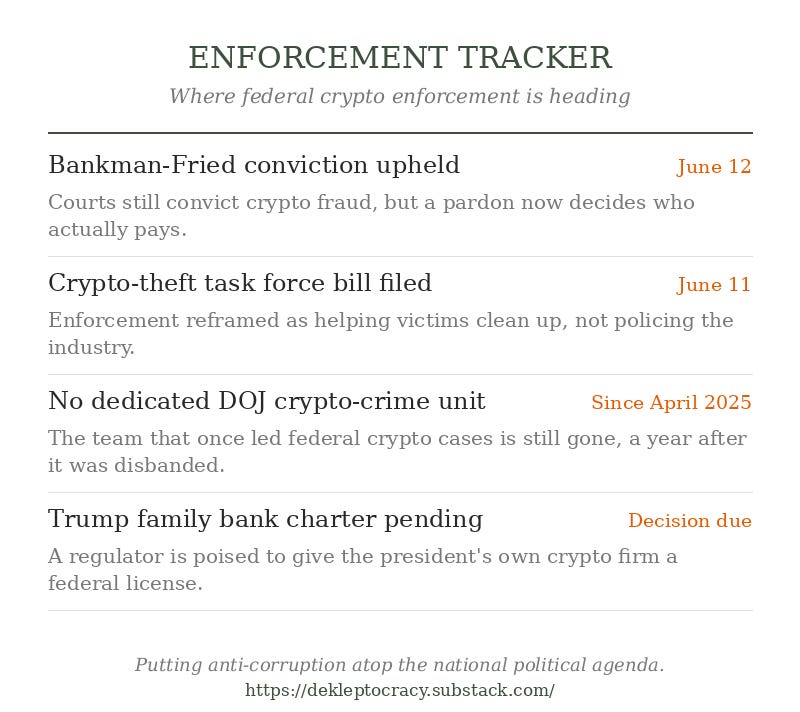
The clearest signal of where federal crypto enforcement is heading came on June 11, when a bipartisan pair of House members introduced a bill to build a Federal Cryptocurrency Theft Task Force. This team pulls together different agencies under one roof.
This one would sit inside the Justice Department, answer to the attorney general, and bring in the FBI, Homeland Security, and the Treasury. Its job would be narrow on purpose. It would help victims of crypto theft and hacking, not police the industry. Representative Josh Gottheimer, a New Jersey Democrat, said that despite 11 billion dollars in thefts and scams last year, victims have nowhere to turn.
Here is the part that tells the story. The reason victims have nowhere to turn is that this same administration tore down the team that used to help them. In April 2025, the Justice Department disbanded its National Cryptocurrency Enforcement Team, the unit that led crypto-crime cases, arguing that it had been regulating the industry through prosecution. So Congress is now trying to rebuild, voluntarily, a smaller piece of what was demolished a year ago. The direction is plain. Enforcement against powerful insiders is giving way to pardons, while enforcement for ordinary victims is being rebuilt from scratch, if it passes at all.
ORDINARY AMERICANS HARMED
Start with a number that has human faces behind it. Americans lost about 11 billion dollars to crypto theft and scams last year, and most never saw a dollar of it again.
That figure is the whole reason for this week’s task force bill. It covers retirees drained by romance and investment scams, people whose digital wallets were emptied by hackers, and small investors wiped out when tokens collapsed. The bill effectively admits that the government left these people without a single phone number to call.
The losses are not only from criminals. They come from the products too. People who invested in the public company tied to World Liberty Financial have lost most of their money, with the stock down more than 90 percent, while the Trump family collected its fees up front. When the people who design a token keep the gains and the public absorbs the fall, the line between a scam and a sanctioned product gets very thin.
CORRUPTION RECEIPTS
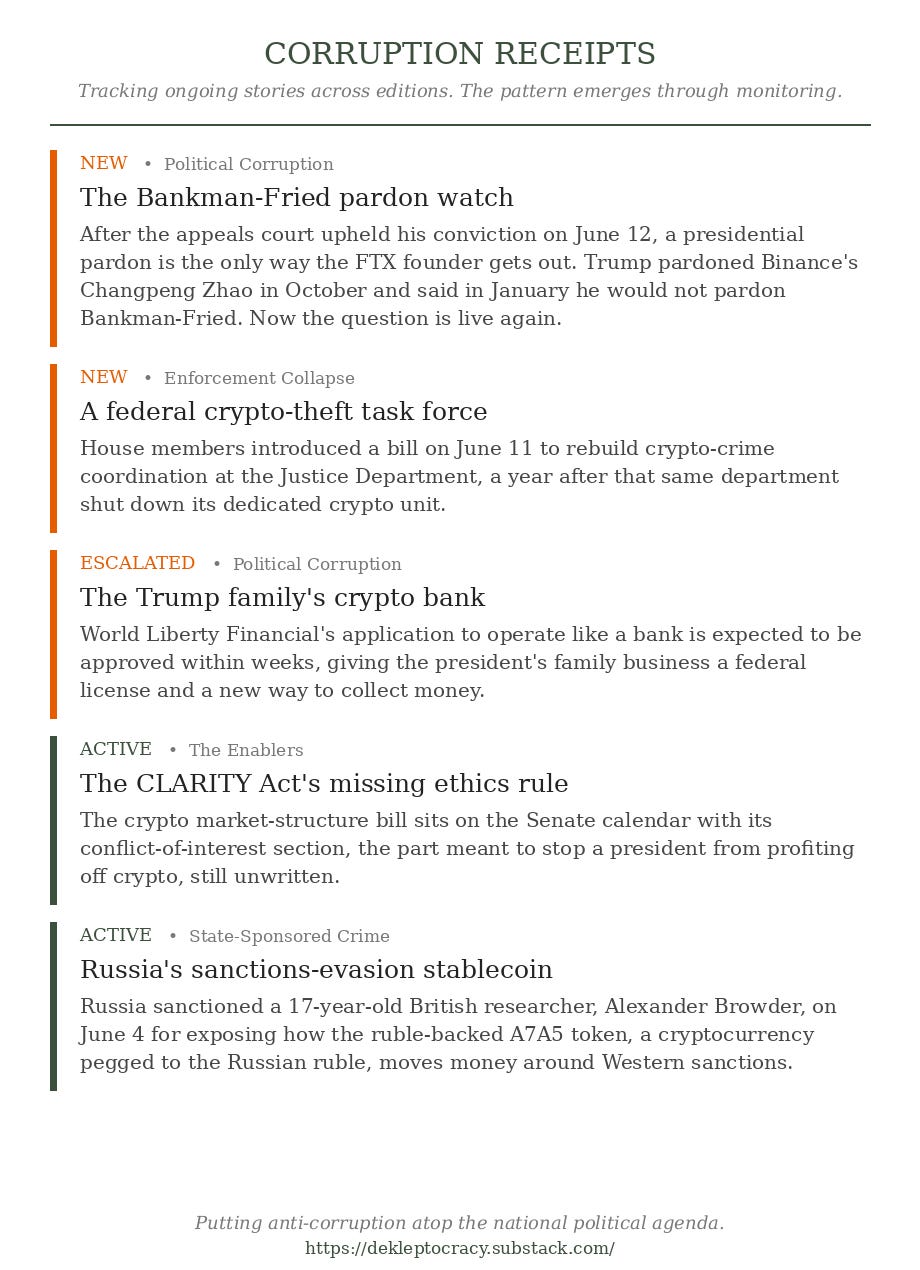
This section tracks ongoing crypto corruption stories across editions. A case stayed this week, a donation next week, a policy change the week after. The pattern only emerges through persistent monitoring.
ONE THING TO WATCH
Watch the Office of the Comptroller of the Currency. Within weeks, Comptroller Jonathan Gould is expected to decide whether to grant World Liberty Financial its bank charter. Approve it, and the president’s family business gets the federal government’s stamp and a fresh pipeline for money to reach the president. It would be the clearest test yet of whether any line still separates the administration’s crypto policy from the Trump family’s crypto profits.
We know we can always improve how we explain things. Please help us understand where we need to explain things better.