


Crypto corruption in focus
Three things most Americans do not realize are connected. The price of gas at your local pump. The war in Iran. And the Trump family’s private crypto company. They are all the same story.
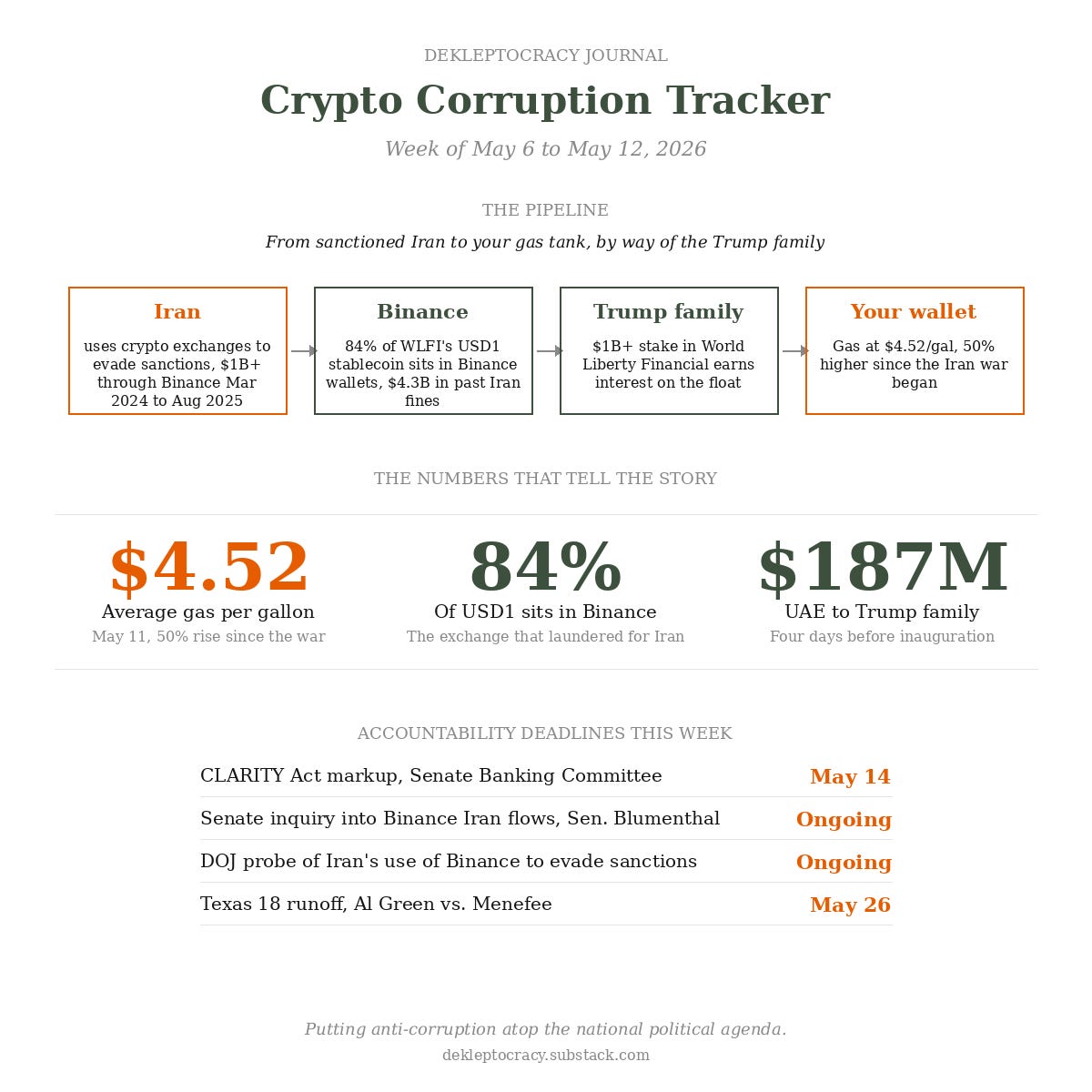
The AAA national average for regular gasoline climbed to $4.52 per gallon on May 11, up more than 50% since the war with Iran began in late February. Gas cost just under $3 a gallon before the U.S. bombed Iran. Eight in ten Americans now say gas prices are straining their budgets. 63% of Americans say they blame President Trump.
Ordinary Americans may be busy paying at the pump, but the Trump family has been busy expanding its business with Binance. This crypto exchange pleaded guilty in 2023 to helping Iran evade sanctions and paid $4.3 billion in penalties, one of the largest corporate fines in U.S. history. Public Citizen, a nonpartisan watchdog group, published a detailed report on April 27 titled Conflict Coin, showing how the Trump family’s World Liberty Financial (the private crypto company in which Donald Trump and his three sons hold a billion-dollar stake) is structurally dependent on Binance. WLFI’s main product is a stablecoin (a digital token designed to maintain a one-to-one value with the U.S. dollar) called USD1. Binance holds 84 percent of all USD1 in circulation. The float earns interest on Treasury reserves. The Trump family pockets that interest.
That is not the worst part. From January 2019 to May 2022, Binance willfully caused over $898 million in trades between U.S. users and users in Iran by failing to implement controls required by U.S. sanctions, according to the Department of Justice. It admitted to those violations in November 2023. Yet entities tied to Iran still received more than $1 billion in Binance funds from March 2024 through August 2025, according to Binance’s internal compliance documents reviewed by Fortune. Then, Binance fired at least five of the investigators who brought it to light. Senator Richard Blumenthal opened a Senate inquiry in February into $1.7 billion that flowed through Binance to Iranian proxies and Russia’s shadow fleet. The DOJ opened its own probe in March.
And on March 21, March 28, and again on April 20, while Americans were fighting a war against Iran, World Liberty Financial and Binance jointly rolled out promotions to encourage USD1 holders to keep their stablecoins on Binance. You may recall that Trump was threatening war crimes at the time. Thus, while simultaneously threatening a little light war criming from the Oval Office, Trump’s company doubled down with a partner the United States government is criminally prosecuted for helping Iran evade sanctions that Trump says were ineffective at preventing the war that he started.
Why this matters: The President of the United States holds a personal financial stake in a stablecoin whose primary distribution partner has been laundering money for the country with which we are currently at war – and that’s to say nothing of Russia, China and many terrorist groups. We shouldn’t have to point this out, but here we are: The US loses credibility when the President and his chief peace negotiator profit from a platform that undermines the country’s own war. Public Citizen’s report argues the arrangement may violate the Constitution’s Foreign Emoluments Clause, which, of course, it does. But arguments about the Foreign Emoluments Clause miss the titanic national security crisis in which the US finds itself.
Four days before Trump returned to office, his crypto company struck a deal with the deputy ruler of Abu Dhabi, who is also the UAE’s national security adviser and the brother of the UAE’s king. The UAE official’s transaction routed $187 million to Trump family entities in exchange for a 49% stake in the same company, which then deepened its partnership with Binance.
What it means for ordinary Americans: You pay twice. First, you pay at the pump. Then, you pay again as a citizen of a country whose President is monetizing a war you are funding with taxes and grief.
If our children are unlucky, they will pick up the tab for the third bill that could come due. You may remember that this UAE official has close ties with the Chinese military. And it was this relationship and the transaction surrounding it that unlocked America’s most advanced AI chips, which may very well someday help train the Chinese military’s AI models to undermine the US.
What to watch: On Sunday, Trump rejected Iran’s counterproposal to end the war. Brent crude futures topped $104 a barrel on Monday. Trump on Monday floated a temporary suspension of the federal gas tax, an idea that would require an act of Congress.
The enabler watch
This week, the enabler is Steven Witkoff. Witkoff is the U.S. Special Envoy for Peace, and he leads U.S. diplomatic negotiations with Iran on behalf of the President. He is also a co-founder of World Liberty Financial. He transferred his WLFI ownership stake to his sons in January 2026, the New York Times reported. His sons Zach and Alex remain co-founders. Zach is CEO and has been involved in pitching the company to foreign governments where the US is involved in high-stakes negotiations. For example, here he was pitching the company to Pakistan, at a time when the world worried the two countries could fight a nuclear war.
World Liberty Financial added $280 million to Steve Witkoff’s net worth in the past year alone, bringing his fortune to $2.3 billion, Forbes estimated in April. The largest single payment came from the deputy ruler of Abu Dhabi, which routed $31 million to Witkoff-associated entities in the same January 2025 transaction that routed $187 million to the Trump family. The deputy ruler is also chairman of MGX. This state-backed Abu Dhabi fund in May 2025 directed $2 billion in USD1 to Binance, generating interest income for the Trump and Witkoff families on the resulting Treasury reserves.
Witkoff is negotiating peace with Iran on behalf of the United States. At the same time, his sons run a crypto company whose business depends on a Binance partnership that continues to handle Iranian transactions in violation of U.S. sanctions. He is conducting that same diplomacy with countries (the UAE, Pakistan, Saudi Arabia) whose governments are simultaneously commercial partners of his sons’ company. If Iran were to demand crypto payment in USD1 for its Strait of Hormuz toll system, which it has already started demanding in bitcoin, the President of the United States and his chief peace negotiator would have a direct financial reason to lift sanctions on the country they are negotiating with.
There is no good outcome for the public here. The man making peace on behalf of the American people has a billion-dollar incentive to make the wrong kind of peace.
Crypto’s golden calf of Doral
For the avoidance of doubt, the president that the crypto industry bought wants to prove to America that the crypto industry is the most corrupt “industry” in American history by accepting a giant gold statue of himself from a memcoin promoter and assembling it at his golf course. Even taking the entire corpus of Trump’s Saddam Hussein-esque architectural aesthetic into account, it is easily the most cringe-inducing. You can judge for yourself.
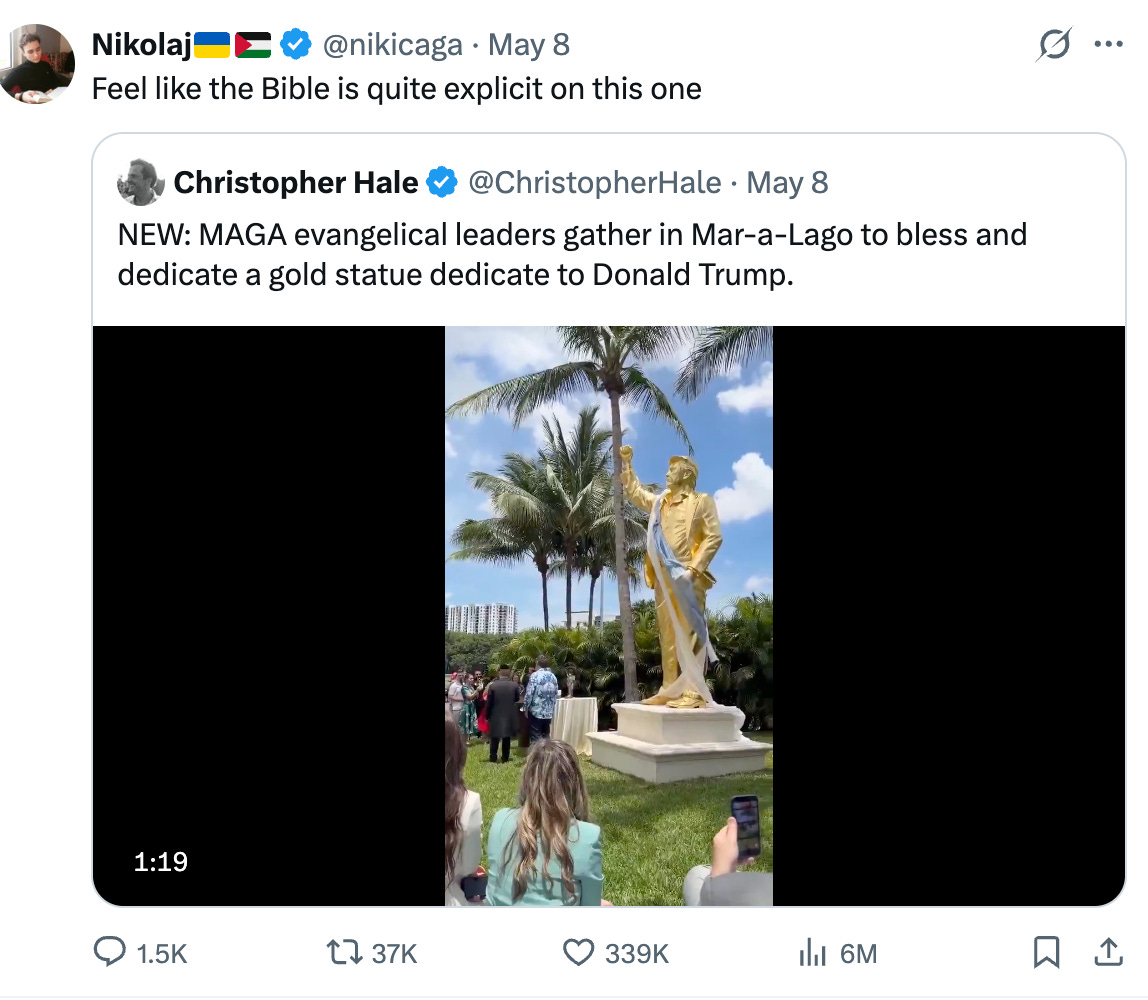
While the Trump family has been profiting from Iran sanctions evasion, another group of crypto investors has been playing a more theatrical role in the same con. On Wednesday, May 6, a 22-foot (!) golden statue of Donald Trump, depicting his raised fist, was unveiled at Trump National Doral Miami. The statue is called Don Colossus. It was paid for by a group of cryptocurrency investors promoting a memecoin called $PATRIOT.
Pastor Mark Burns, the president’s informal spiritual adviser, led the dedication ceremony and held his phone to the microphone so Trump could call in and personally thank everyone. Then, that same night, Burns wrote on X, unprompted, “Let me be clear. This is not a golden calf. We worship the Lord Jesus Christ and Him alone.”
The Miami New Times and the Daily Beast have reported the cost breakdown. $300,000 for the bronze. $60,000 for the gold leaf. $150,000 for the rights to use the statue’s image to market $PATRIOT. The sculptor, Alan Cottrill of Zanesville, Ohio, who has more than 400 life-size or larger statues across the country, called the project a “clusterfuck.” Asked whether the result was an accurate likeness, Cottrill told the New Times that his patrons had pushed him to slim the president down. “I had him even skinnier than he is, a little bit. I knew they’d want that,” he said of his first clay model. “They said, ‘Oh, he’s too big.’” Cottrill, who is 73, added that he had understood the request. “I’m close enough to his age, and I got some turkey neck going on, and I knew what that was. That’s what happens when you’re almost 80.”
The crypto investors named in news reports include Ashley Sansalone, a Canadian crypto developer, and Dustin Stockton, a Republican strategist. You may recall that name. Stockton’s last public political role was vice president of strategy and marketing for We Build the Wall, the private border-wall fundraising effort co-founded by Steve Bannon. In August 2020, federal agents served warrants on Stockton’s phones and a grand jury subpoena in connection with the federal investigation that led to fraud and money-laundering charges against Bannon and Brian Kolfage. Bannon, Kolfage, and two others were indicted. Stockton was never charged. It seems he reinvented himself as what he calls a meme coin kingpin. He has been a vocal public defender of the Don Colossus on X, mocking critics.
$PATRIOT itself has performed about as you would expect of a memecoin once its primary publicity event is complete. Around Trump’s January 2025 inauguration, the coin had a market cap of roughly $77.7 million. As of this writing, CoinGecko lists the market cap at $692,000, a 99 percent decline from the peak.
The sculptor, asked by the Miami New Times whether he would work with the group again on the planned Trump Presidential Library statue, did not need to hear the rest of the question before refusing in two profane words.
The Don Colossus is the Trump corruption economy in “miniature.” Insiders extract real money from real Americans by selling them a story. The story now stands in a clearing of palm trees at a Trump golf course, $510,000 of crypto-investor cash converted into a gilded fist of the president whose policies turn the same crypto pipeline into a billion-dollar inheritance for his sons. But it is not a golden calf.
The money trail
Congressman Al Green of Texas is now one of the loudest voices in Congress on what crypto money is doing to our democracy. In a March 19 House floor speech, Green accused the crypto industry of spending mega millions to control Congress. And he is right. Green has argued that lawmakers cannot allow the crypto industry to own Congress. He has been right on this from the start, and viral clips of his speeches have continued to spread this week.
Protect Progress, a super PAC affiliated with the crypto-industry-funded Fairshake network, has spent at least $1.5 million in advertising against him in the Texas 18th Congressional District primary. Green is a 20-year incumbent who has voted against every major piece of pro-crypto legislation (the GENIUS Act, the CLARITY Act, H.J. Res 25), according to the crypto industry’s own scorecard. He has been removed twice from the House chamber for disrupting Trump’s speeches. Now the industry he is fighting is trying to permanently remove him from the House. His runoff against Rep. Christian Menefee is on May 26.
Fairshake itself reported $193 million in cash on hand at the start of 2026, more than the group spent across the entire 2024 cycle. In 2024, 53 of 58 Fairshake-backed candidates won their races. The industry is on track to spend an order of magnitude more in 2026.
Where does that money come from? It comes from companies that benefit when Congress does what the industry wants. Ripple donated $25 million to Fairshake in the second half of 2025, after the SEC dismissed its case. Andreessen Horowitz donated $24 million. Coinbase donated $8 million after its own SEC case was dismissed. Each of those firms also donated at least $1 million to Trump’s 2025 inauguration, according to a January 2026 letter from House Democrats. The letter alleged a pay-to-play scheme.
If you want to see this pipeline mapped out, our 501(c)(3) affiliate Anti-Corruption Action has built the Quid Pro Quo Tracker (live at purchasingpolicy.org). It lets anyone visualize the donor-to-recipient-to-legislation pipeline, including the think tanks that justify the laundering of policy. It already shows Senators Elissa Slotkin and Ruben Gallego as two of the largest recent recipients of crypto-industry money among the Democrats who provided the swing votes for the GENIUS Act. This stablecoin law gave the Trump-Witkoff USD1 a federal regulatory home. The Sunlight Foundation database, which was used to track political donations, shut down a couple of years ago. Anti-Corruption Action hopes to fill some of that gap with this tool. The Al Green speech makes the case. Purchasing Policy provides the evidence. Use it. Share it.
Enforcement tracker
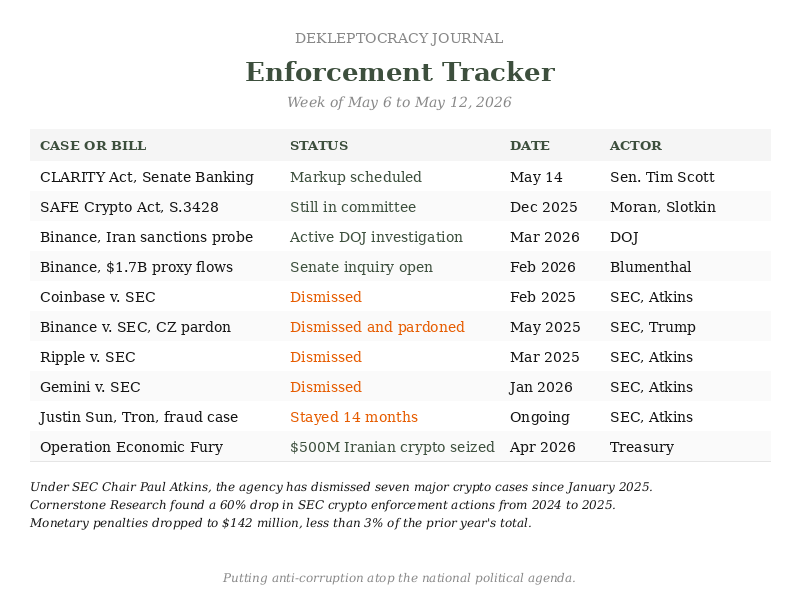
Two pieces of crypto legislation are moving through the Senate this week. Neither will protect ordinary Americans from the corruption documented above.
The SAFE Crypto Act (S.3428), introduced by Senators Jerry Moran (R – KS) and Elissa Slotkin (D-MI) in December, creates a Treasury-led federal task force on cryptocurrency scams. The task force requires the inclusion of representatives of permitted payment stablecoin issuers and encourages industry participation in real-time interdiction networks. In plain English, the same companies whose products are used to launder the proceeds of human trafficking, sanctions evasion, and pig butchering scams get a seat on the body that will tell Congress how to regulate them. The bill has been sitting in the Senate Banking Committee since its introduction in December.
Without a hard prohibition on insiders profiting from stablecoin float, the SAFE Crypto Act will not change the incentive structure that put $4.2 billion of USD1 into Binance’s wallets in the first place. And putting Binance and Tether under the body that polices Binance and Tether speaks for itself.
The CLARITY Act is the bigger fight. The Senate Banking Committee unveiled the latest text of the Digital Asset Market CLARITY Act just after midnight on Tuesday, May 12, ahead of a Thursday, May 14, committee markup. The bill would split federal oversight of crypto between the Securities and Exchange Commission (SEC) and the Commodity Futures Trading Commission (CFTC), resolving the long-running (and absurd) question of when a token is a security or a commodity. Five major banking trade groups, including the American Bankers Association, formally rejected a compromise put together by Senators Thom Tillis (R – NC) and Angela Alsobrooks (D – MD). Senate Banking Republicans hold 13 of 24 seats so that the markup could pass on a party-line vote. But the bill needs 60 votes on the floor, which means passage cannot happen without Democrats. The ethics provision that would bar a sitting president from owning a stablecoin company, the only language that would prevent a repeat of the WLFI arrangement, will not be in Thursday’s Banking Committee text.
Ordinary Americans harmed
Gas prices since the war with Iran began have risen 50%, from just under $3 a gallon to $4.52 on Tuesday’s AAA reading. California has reached $6.16 a gallon. The average two-car household has lost an estimated $200 a month at the pump since late February.
That is not the only way crypto and Iran connect to your wallet. As the war stretches into its 11th week, Iran has been accepting bitcoin and other cryptocurrencies for tanker transit through the Strait of Hormuz, the narrow waterway that carries roughly 20 percent of the world’s seaborne oil. Iran’s shipping toll system is a tax on global commerce that did not exist a year ago. Every ship that pays the toll is paying with a financial instrument that the Trump administration’s policies have helped legitimize. The pace of Iranian crypto activity is now estimated at $8 to $10 billion a year by TRM Labs, a blockchain analytics firm. Most of that money funds the regime, which is why gas costs $4.52 a gallon.
North Korea’s Lazarus Group stole $577 million from two American-facing crypto platforms in April alone, according to TRM Labs. That money funds the regime’s nuclear and missile programs.
Corruption Receipts
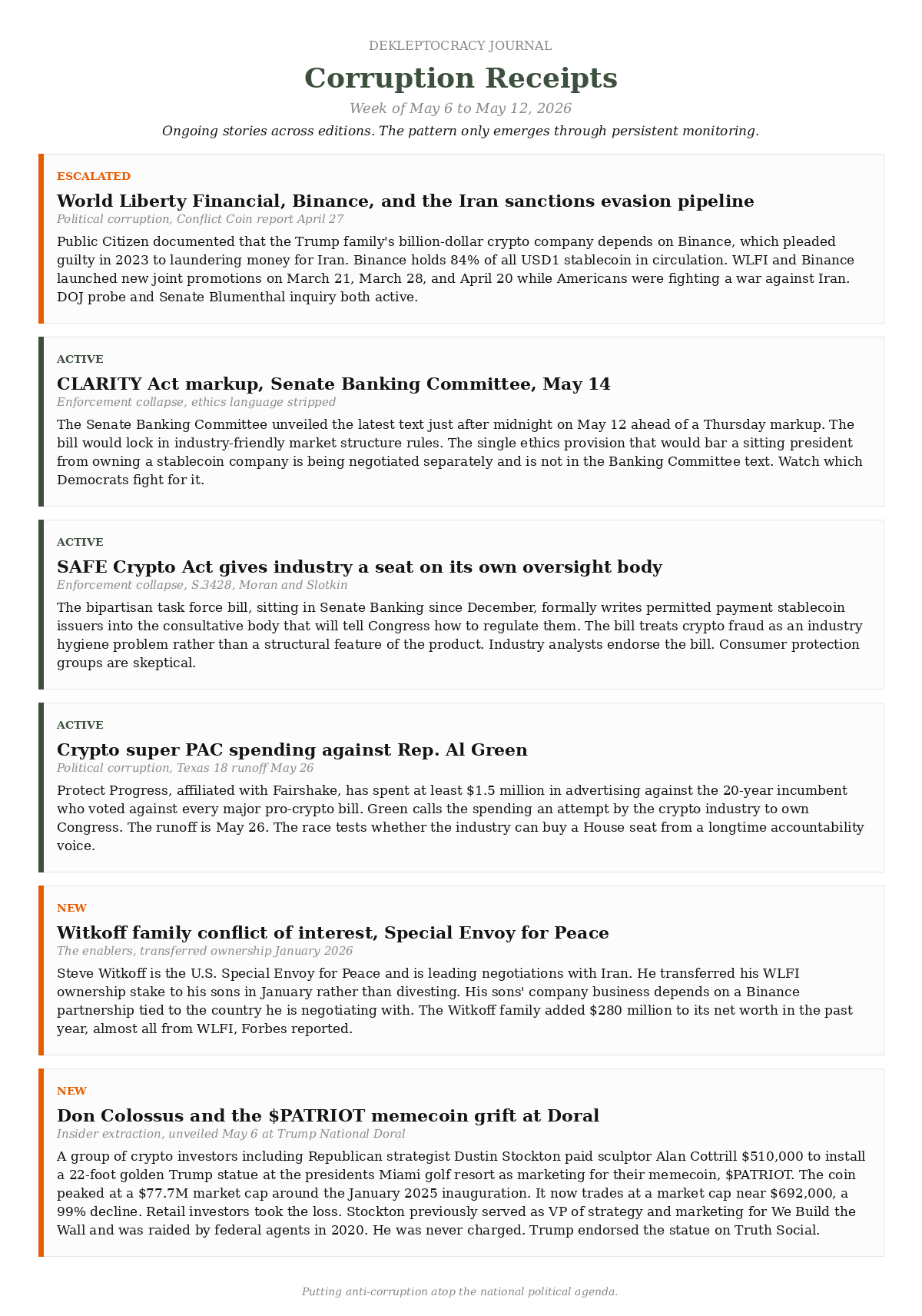
This section tracks ongoing stories across editions. A case stayed this week, a donation next week, a policy change the week after, the pattern only emerges through persistent monitoring.
One thing to watch
Thursday’s CLARITY Act Senate Banking Committee markup will reveal whether Democrats are willing to hold the line on a single ethics provision, barring the President of the United States from personally profiting from the stablecoin industry he is simultaneously regulating. The amendment is straightforward. Senator Tim Scott (R – SC), the committee chair, controls the calendar. Watch which Democrats demand the ethics language as the price of their vote, which ones quietly let it slide, and which Republicans on the committee will or will not allow the language to be offered as an amendment. The markup convenes Thursday morning, May 14, Eastern time.
Also, keep an eye on Texas 18 on May 26. Whether the crypto industry can spend $1.5 million to defeat the loudest anti-crypto-corruption Democrat in Congress will tell us what the rest of the 2026 cycle looks like.
Dekleptocracy Journal is supported by Dekleptocracy Alliance, a Texas 501(c)4, an investigative transparency activist that incubates independent transparency organizations in order to put corruption at the top of the US political agenda. Like the rest of our projects, someday this will be an independent organization.
The US is shockingly corrupt, and that’s not just because of our current administration. We’re building organizations that will help Americans talk about it more often. You can support our mission here.