


Crypto corruption in focus
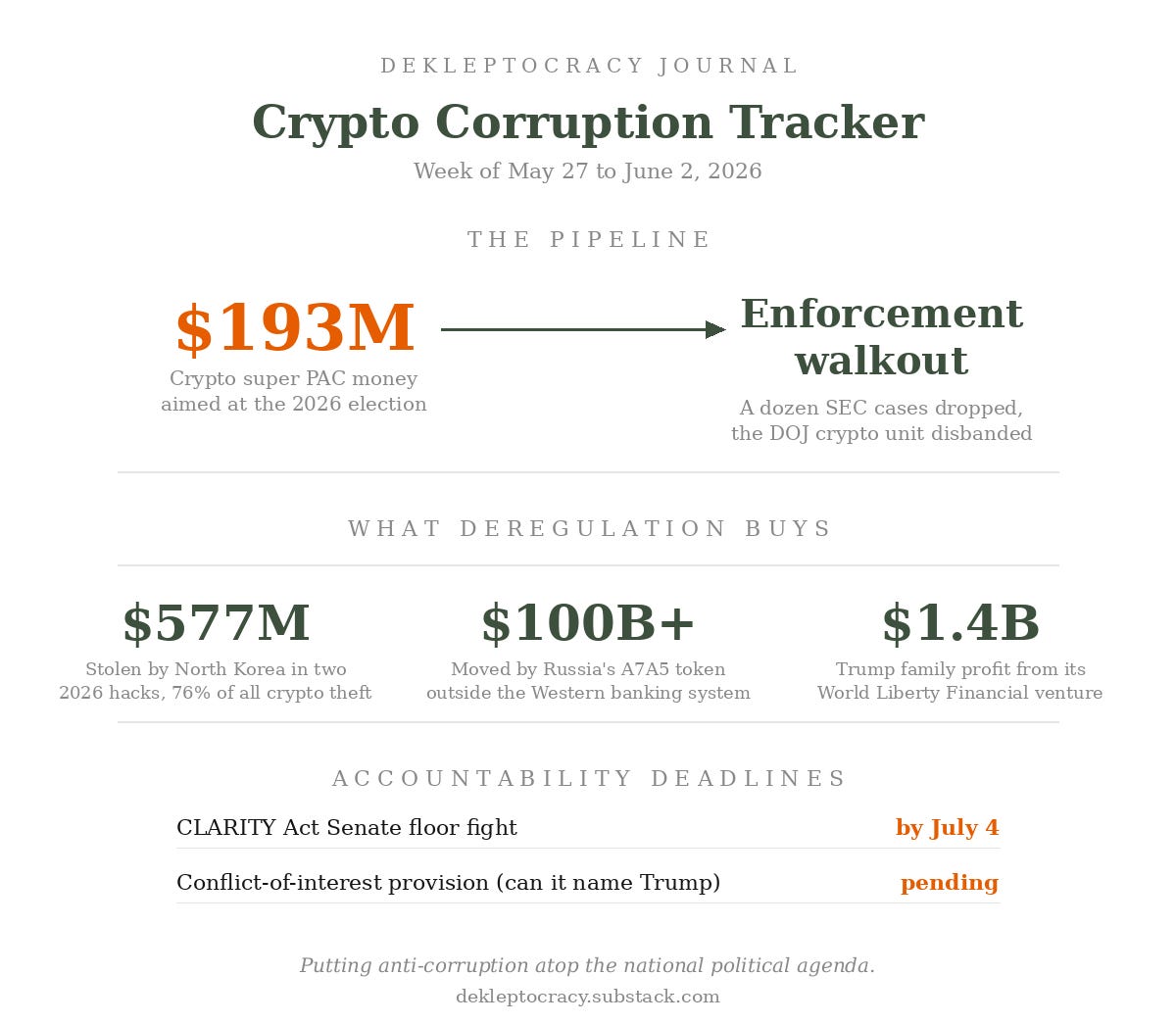
On May 27, the British government sanctioned 18 crypto companies and individuals, including the large exchange HTX, for helping Russia circumvent Western trade bans. It was the newest sign of something the libertarian founders of cryptocurrency never put in the brochure. Money with no banks and no regulators works best for the people the United States most wants to stop.
A Russian, ruble-backed stablecoin called A7A5, a digital token built to run outside the Western banking system, crossed $100 billion in transfers within a year, becoming the largest non-dollar stablecoin on earth. North Korea’s state hackers stole $577 million in just two thefts from American crypto platforms this year, money the regime spends on missiles and nuclear weapons. Iran’s exchanges are surging. China’s laundering networks carry the cash.
The president of the United States is personally getting rich from the same industry. The Trump family has earned at least $1.4 billion from its crypto venture, World Liberty Financial, while the administration he runs dismantles the investigative units that pursue sanctions evasion and stolen funds. The cop is on the suspect’s payroll.
What to watch next: The Senate is now fighting over whether a sweeping new crypto law is even allowed to mention the president’s conflicts of interest. That this abomination should not even become law does not seem to be in the cards.
The enabler watch
This week’s enabler is a Democrat who knows better. Senator Elissa Slotkin of Michigan spent years as a CIA officer and a Pentagon official. Few people in Congress understand as well as she does how hostile regimes move money. She has said as much, pointing to the national security risks in crypto.
Then she helped the system grow anyway.
In June 2025, Slotkin voted for the GENIUS Act, the law that gave stablecoins, dollar-pegged crypto tokens, their first federal seal of approval and pushed them toward the financial mainstream. That law appears to have been custom-built to facilitate Trump’s crypto ventures. The crypto industry’s main political fund spent about $10 million to help elect her in 2024. The industry and Trump’s ventures prize the credibility that her trusted national security voice lends them/
Does a former intelligence officer grasp that the stablecoin rails she helped legitimize are the same ones Pyongyang, Moscow, and Tehran now ride? Or does winning Michigan overrule those concerns? Her voters deserve an answer.
The money trail
The same names reappear over and over. Fairshake is a super PAC, meaning it can raise and spend unlimited sums to sway elections. And spend it has. It amassed $193 million for the 2026 midterms, more than it deployed in all of 2024.
Andreessen Horowitz, the Silicon Valley firm known as a16z, supplied $24 million of that, and its founders Marc Andreessen and Ben Horowitz each wrote personal checks of nearly $12 million. By spring, a16z had become the largest disclosed political donor of the cycle, outspending George Soros and Elon Musk.
Then there is Peter Thiel, the PayPal billionaire who turned crypto-libertarianism into a fortune. Thiel’s Founders Fund bankrolled Bullish, a crypto exchange that now owns the trade outlet CoinDesk, and he is the patron who launched Vice President JD Vance.
None of these men set out to fund Pyongyang’s bomb. But the deregulation they are buying – fewer rules, no banks and weaker watchdogs – facilitates precisely that. You cannot build a money system designed to dodge governments and then act shocked when the most sanctioned governments on earth move in.
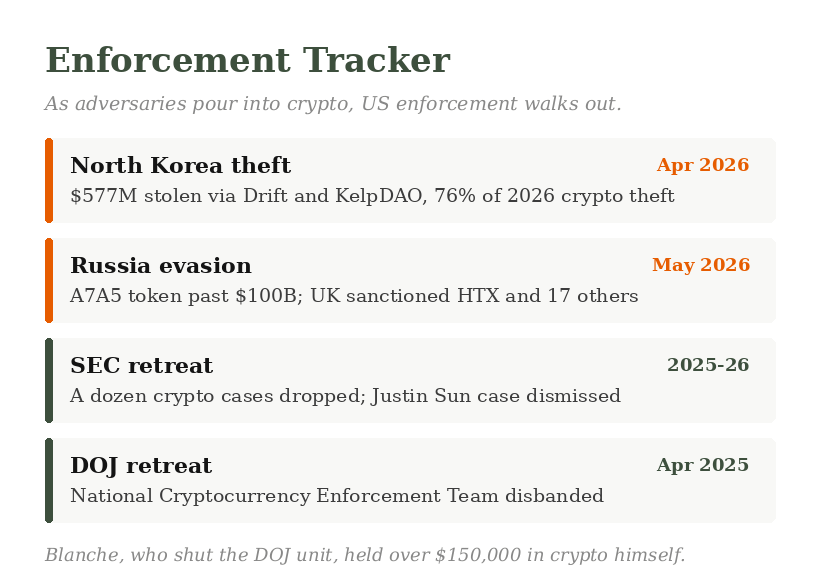
Enforcement tracker
As foreign thieves and sanctioned states pour into crypto, American enforcement is walking out the door. By design.
Ordinary Americans harmed
The finance industry and Trump love crypto because they’re getting rich from it, but you’re picking up the tab. When North Korea drained the KelpDAO platform in April, frightened lenders rushed to the largest crypto lending site, Aave, and some ordinary depositors found they could not withdraw their own money. Decentralized finance, or DeFi, is lending run by software instead of banks, with no deposit insurance and no one to call.
The savings Americans park in these apps chasing high returns are the raw material North Korea turns into warheads. Every retiree and small investor who feeds the machine is, without knowing it, helping fund the regimes that threaten the country. That will then require every American taxpayer to spend more on defense.
The administration’s goal has been to obliterate the rules, which cleared a path not only for the rogue regimes but also for the Trumps. The Trump family stablecoin, USD1, has ballooned past $5 billion. The family collects the profits on that, and the regulators who decide how closely to watch it answer to the president himself.
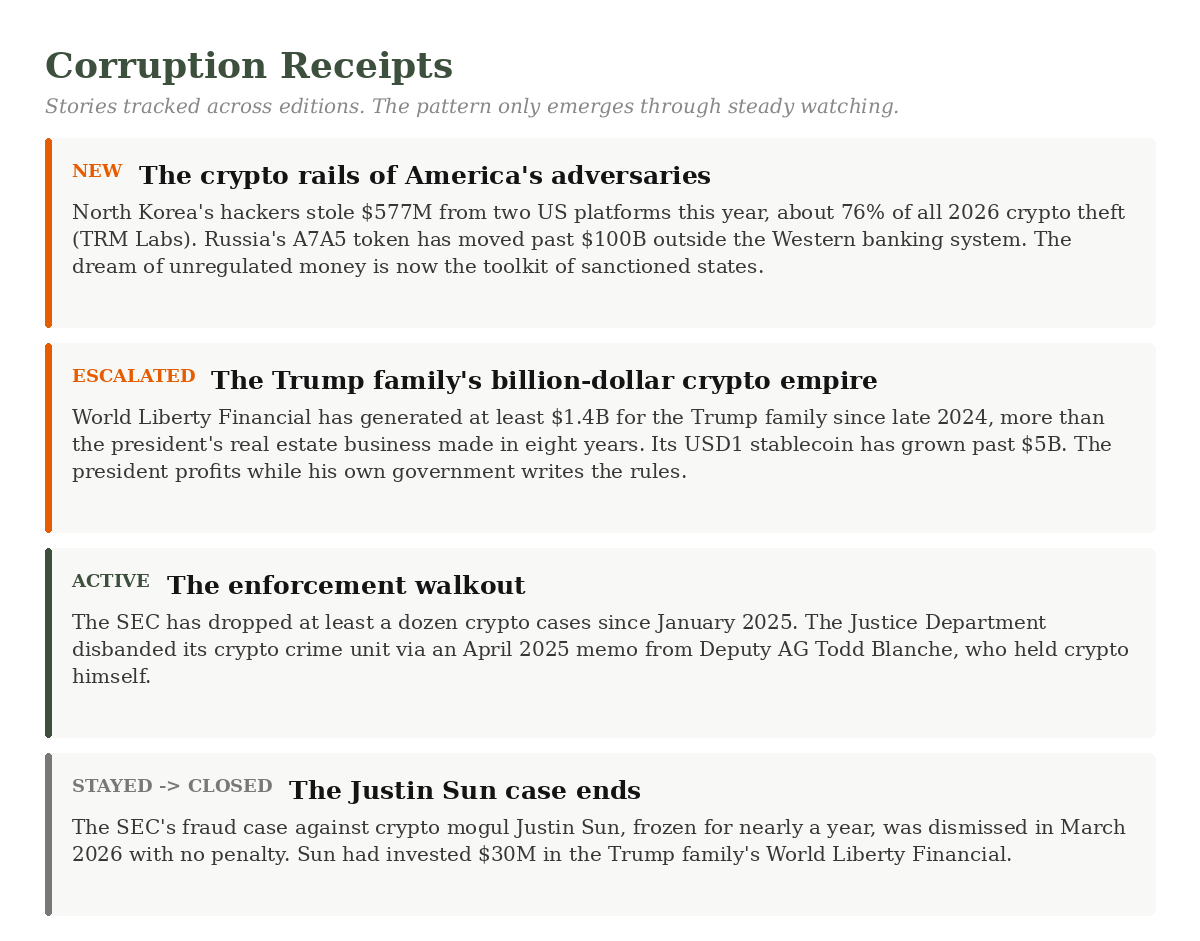
Corruption Receipts
This section tracks ongoing stories across editions. A case dropped one week, a donation the next, a policy change the week after…
One thing to watch
The CLARITY Act, a sweeping bill that would move most crypto oversight to the friendlier Commodity Futures Trading Commission and away from the SEC, is heading for a Senate floor fight, with the White House pushing for passage by July 4. Watch the conflict-of-interest section. Democrats want language barring the president from profiting; the White House has said it will not accept any bill that singles him out. A responsible Democratic Party would just tank the entire thing.
Dekleptocracy Journal is supported by Dekleptocracy Alliance, a Texas 501(c)(4), an investigative transparency activism fund that incubates independent transparency organizations that put corruption at the top of the US political agenda. Like the rest of our projects, someday this will be an independent organization. Your subscriptions will help us reach that goal.
The US has grown cartoonishly corrupt, and that’s not just because of our current administration. We’re building organizations that will help Americans talk about the corruption crisis more freely, so that we can get on a path to restoring our democracy. You can support our mission here or explore our transparency portfolio here.
And, as always, let us know how to explain this stuff more clearly. That is our mission, after all. We always need to be improving on that score.
My goodness, thank you. What shocking news. Getting this information to the states in the middle of the country seems so hard… getting it to anyone.
Maybe seek to light up some country singers and some church pastors? A famous singer could write a sort of explanatory song… kind of like Bruce Springsteen did on the last Colbert show.
Individual reach-out….See if a one to one information and advocacy campaign might work. Ask AI how best to get it to everyday people. Messages in fortune cookies?
What a world.